What is Smoke Testing in Software Development?
When we ask what is smoke testing, we are describing a non-exhaustive, shallow set of tests that verify the most critical “golden paths” of an application. It is the first line of defense in the software development life cycle (SDLC).
The primary goal of a software testing’s smoke test is to verify build stability. It ensures that the basic functionalities — the heartbeat of the app — are intact. For a modern B2B SaaS company, this usually means checking if:
- The application starts and the main UI loads.
- Users can authenticate (Login/Logout).
- The core database connection is active.
- The most critical business feature (e.g., “Add to Cart” or “Generate Report”) is functional.
Without these basics, your outsourced QA or internal team is just spinning their wheels. Ensuring these “golden paths” work is the foundation of professional software QA services.
Smoke vs. Sanity vs. Regression
One of the most common questions we get as a quality assurance & testing company is: “What’s the difference between smoke, sanity, and regression testing?” While they often overlap, confusing them can lead to a messy strategy.
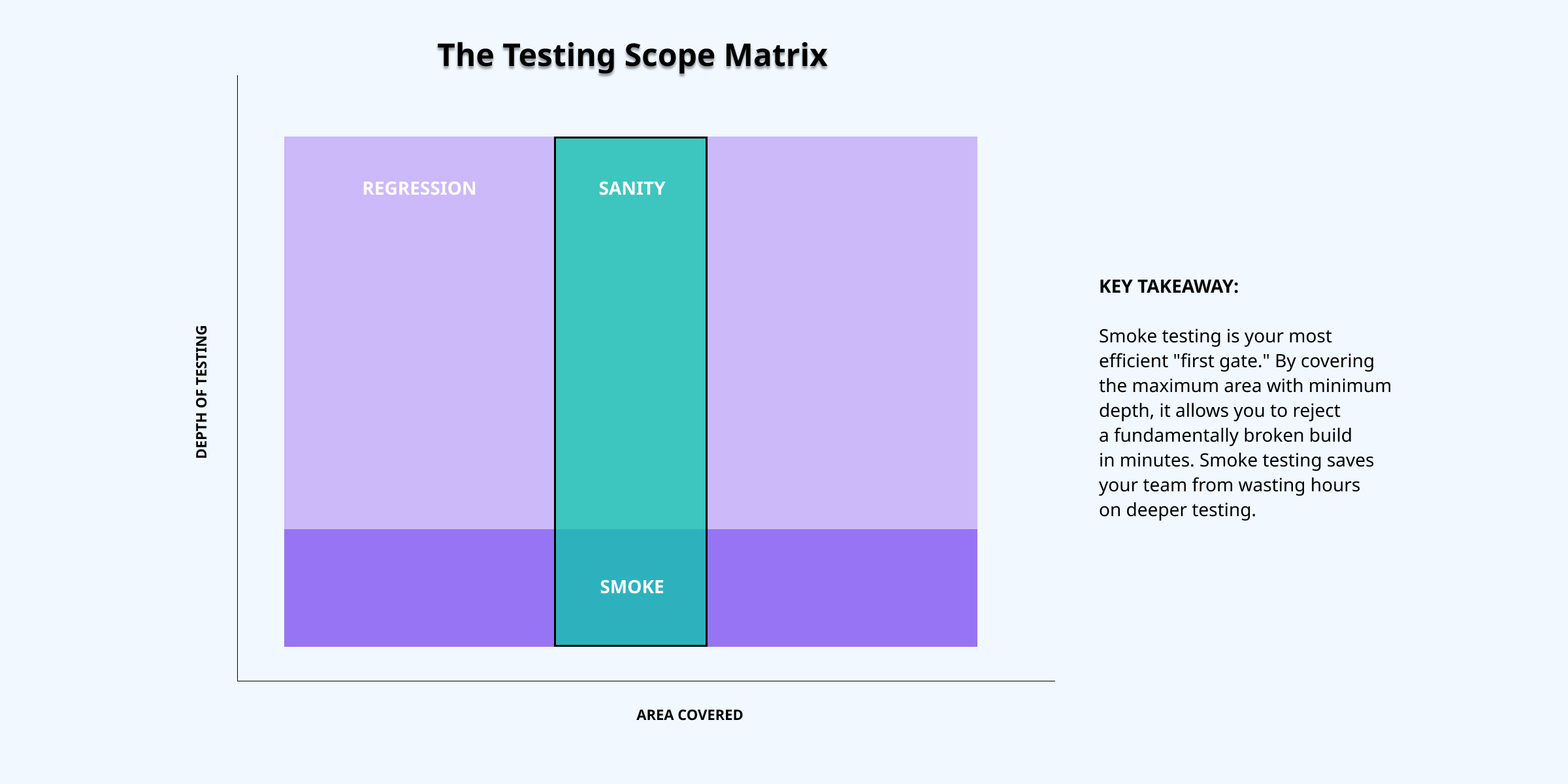
- Smoke Testing: The “Health Check.” It’s a wide but shallow sweep. It asks: “Is the house on fire?”
- Sanity Testing: The “Logic Check.” It’s narrow and deep. It usually happens after a bug fix and asks: “Does this specific feature now behave rationally?”
- Regression Testing: The “Stability Check.” It’s wide and deep. It asks: “Did our new fixes accidentally break the neighbors?”
In a high-velocity software testing company, smoke testing is your first gate. Only after the smoke test passes do you move into the more detailed smoke testing vs regression testing phase. Understanding this hierarchy allows your QA resources to be used strategically rather than just “testing everything” at random.
Types of Smoke Testing
Choosing the right types of smoke testing depends on your project’s maturity. While many believe you have to choose between “fast” and “thorough,” a quality assurance & testing company knows that the best strategy is often layered.
1. Manual Smoke Testing
In this scenario, a QA specialist follows a high-level script to check core features by hand. While it offers a human “feel” for the product, it can become a bottleneck as your product grows. Manual software testing is great for early-stage POCs where the UI is changing daily.
2. Automated Smoke Testing
For scaling teams, automated smoke testing is the standard. Scripts are written to handle a lot of repetitive checks. This is where smoke testing automation shines, providing feedback in minutes not hours. It allows your senior specialists to focus on exploratory work rather than clicking the “Login” button for the 500th time.
3. General or Hybrid Smoke Testing
This is our typical way. We move away from the “silo” model where separate engineers handle different tasks. Instead, one QA resource handles the full cycle. They manually verify a fix to understand the logic, then immediately “promote” it into the automated safety net. Our approach ensures that the person who understands the feature best is the one building its permanent protection. Using this QA outsource model eliminates the “translation gap” where manual testers have to explain bugs to automation engineers, saving your company significant time and money.
A Step-by-Step Blueprint on How to Perform Smoke Testing
Knowing how to perform smoke testing is essential for maintaining a high-velocity workflow. You don’t want to over-complicate this phase — it should be fast, reliable, and decisive.
- Identify Critical Functionalities: Determine which 5-10 features are absolutely vital. If these fail, the product is useless.
- Create Test Cases: Write simple, “positive” test cases. We aren’t trying to break the system here — we’re checking if it works under normal conditions.
- Execute the Suite: Run the tests immediately after the build is deployed to the staging environment.
- Analyze and Report: If the tests pass, the build is “Green” and moves to regression testing services. If even one test fails, it’s a “No-Go,” and the build is sent back to developers.
Working with a professional software testing company helps in defining these steps so that your outsourced software testing is consistent and reliable.
The 3 Pillars of a Successful Smoke Suite
To ensure your software QA services actually provide ROI, a smoke test must meet three specific criteria. If it fails even one of these, it becomes a bottleneck rather than a gatekeeper.
- Speed (The 10-Minute Rule): A smoke test should never take an hour. In a modern CI/CD pipeline, developers need feedback fast. We aim for automated smoke suites that run in under 10 minutes.
- Reliability (Zero False Positives): If your smoke test is “flaky” — meaning it fails when the app is actually fine — developers will stop trusting it. High-quality automation testing services focus on building stable, “non-brittle” scripts.
- Decisiveness (Clear Pass/Fail): There is no “maybe” in smoke testing. It is a binary signal. If the “Add to Cart” button doesn’t work, the build is rejected. Period.
Smoke Testing Example
Let’s look at a smoke testing example for a typical E-commerce platform. If you were a QA engineer at a growing SaaS company, your smoke suite might look like this:
- Test 1. Can the user reach the landing page?
- Test 2. Can a registered user log in successfully?
- Test 3. Does the search bar return results for a known product?
- Test 4. Can an item be added to the shopping cart?
- Test 5. Does the checkout page load without a 500 error?
If the user cannot log in (Test 2), there is no point in testing the “Search” or “Checkout” features. The build is fundamentally unstable.
In fintech, “smoke” usually involves money movement or security. When we provide outsourced software testing for financial apps, we focus on the paths that keep the app legally compliant and functional for the user’s wallet.
- Test 1. Does the multi-factor authentication handshake complete?
- Test 2. Does the main account balance load with real-time data?
- Test 3. Can the user open the “Transfer” or “Pay” screen?
- Test 4. Does the “Recent Transactions” list populate?
- Test 5. Does the app correctly identify the user’s KYC (Know Your Customer) status on launch?
If the Balance Display (Test 2) shows an error or a zero balance when it shouldn’t, it’s a critical failure. This is why automation testing services are so vital here — running these five checks every 10 minutes ensures that your “golden paths” work, even with rapid-fire code deployments.
What’s in healthcare? Software QA services must check that data integrity and accessibility are never compromised. A failure is a potential blocker for patient care. If you were providing mobile QA or web testing for an EHR platform, your smoke suite would focus on these critical flows:
- Test 1. Can a doctor or nurse log in and see their specific dashboard?
- Test 2. Can the user retrieve a specific patient record by ID or name?
- Test 3. Does the “Patient Summary” page load without timing out?
- Test 4. Can a user open a new “Consultation” or “Notes” entry?
- Test 5. Does the system successfully connect to the central medical database?
If the Patient Search (Test 2) fails, the system is essentially a brick for a medical professional. There is no point in having your manual software testing team try to verify complex prescription logic if they can’t even find a patient. The build is rejected immediately.
For a deeper dive into how this differs from other early checks, see our guide on smoke testing vs regression testing.
The Financial Logic
The earlier you find a bug, the cheaper it is to fix. This is a proven economic reality in software smoke testing. Industry benchmarks from IBM show that a logic error caught during the initial development or smoke phase costs 100x less than finding that same error in production.
According to a landmark study by NIST (National Institute of Standards and Technology), catching bugs at the requirements or smoke stage can save companies millions in “shadow costs” like emergency patches and customer churn. By using smoke testing software, you filter out these expensive disasters before they reach your users.
For many B2B SaaS companies, moving to outsourced software testing helps achieve these goals. Our internal data shows that catching bugs early can reduce the time developers spend on fixes from 30% down to just 5–7% of the sprint.
Scaling Efficiency with Automated Smoke Testing
As your engineering team grows by 20% or more, manual testing hits a plateau. This is why smoke testing automation is no longer optional — it is a requirement for survival.
Automated smoke testing integrates directly into your CI/CD pipeline. Every time a developer pushes a pull request, the smoke suite runs automatically. This approach ensures that the core features are protected 24/7. Using automated testing services can reduce your feedback loop from days to just under 10 minutes.
In today’s competitive market, outsourced software testing is moving further “left” — meaning closer to the developer’s first line of code.
When you integrate smoke testing automation into your CI/CD pipeline (using tools like Jenkins, GitHub Actions, or GitLab CI), the test runs the second a developer pushes a pull request. If the code breaks a “Golden Path,” the developer knows instantly. This prevents the “developer tax” from rising, as the fix is made while the logic is still fresh in their mind. This is a core part of our automated testing services and the cornerstone of software testing outsourcing. By automating regression testing and smoke tests, you allow your team to scale without a proportional increase in headcount.
Selenium Smoke Testing as the Industry Standard
When it comes to web applications, selenium smoke testing remains one of the most popular choices. Selenium allows QA specialists to write scripts that mimic real user behavior across different browsers like Chrome, Safari, and Firefox.
Because Selenium supports multiple languages (Java, Python, C#), it fits into almost any smoke testing software engineering stack. By automating your smoke suite with Selenium, you know that your market-readiness is supported across every device combination simultaneously.
This is a key part of the test automation services we also provide to help teams maintain high velocity. You don’t need a massive team; you just need the right QA company and tools.
Smoke Testing in Production Environments
Most people think testing stops at the staging environment, but smoke testing in production environment is the ultimate safety net. In the mobile QA, this is especially critical due to device fragmentation.
With thousands of different screen resolutions and OS versions, a build that works on a simulator might fail on a real device. Mobile app testing requires a specialized smoke suite that checks for connectivity, orientation changes, and core UI rendering. By outsourcing software testing to a specialized mobile QA team, you ensure that your “golden paths” are verified on actual physical devices.
Production smoke testing (or “synthetic monitoring”) involves running a very limited, non-destructive set of tests on the live site after a deployment. It makes sure that environment-specific configurations — like API keys or database strings — are working correctly.
Implementing these QA services ensures everything is “green” before real users start seeing new features. This is a vital component of any professional software QA services strategy.
Why Smoke Testing in Performance Testing is Crucial
A common mistake is skipping the “health check” before a load test. Smoke testing in performance testing acts as a baseline. Before you hit a server with 10,000 concurrent users, you run a single-user smoke test to check if the environment is stable.
If your app can’t handle one user, it certainly won’t handle ten thousand. By using performance testing services with an integrated smoke phase, you avoid “false negatives” and ensure your performance data is accurate and meaningful.
Common Reasons Why Smoke Tests Fail to Deliver
Even with the best outsourced testing team, smoke testing can fail if you fall into these common traps:
- Scope Creep: Trying to test every edge case in the smoke suite. Remember — shallow and wide. Save the edge cases for regression testing services.
- Environment Mismatch: Running smoke tests in an environment that doesn’t mimic production. If your staging database is empty but production is full, your “database connection” smoke test might give you a false sense of security.
- Manual Burnout: Relying exclusively on manual software testing for every single build. This leads to the “manual plateau” we discussed earlier, where your team is too tired to find real bugs.
How to Choose Smoke Testing Tools
Selecting the right smoke testing tools depends on your product’s architecture. Here are some our favorites for 2026:
- Playwright / Selenium: Excellent for UI-based web smoke testing software.
- Postman / RestAssured: The go-to for API-level smoke tests.
- Testmo: A great management system to act as your “Source of Truth” for both manual and automated cases.
- Appium: The gold standard for mobile software testing smoke test suites.
A dedicated quality assurance & testing company will help you pick the tools that fit your existing pipeline. Be sure that your QA resources are spent building QA flows, not just maintaining tools.
Who Owns the Smoke Test?
There is an old-school debate: Should developers or QA engineers write smoke tests?
At QA Madness, we believe in the hybrid specialist model. By outsourcing QA to a specialist who handles both the manual discovery and the automated framework, you get the best of both worlds.
They have the “human intuition” to know which paths are truly business-critical and the technical skill to lock them in with test automation services. This “2-in-1” approach ensures no knowledge is lost in translation and keeps your team lean and efficient.
To Sum Up
At the end of the day, smoke testing in software development is about peace of mind. It’s also about moving from a reactive “bug-hunting” state to a proactive quality culture.
When you implement a general automated smoke testing strategy, you unblock your manual QA specialists, save your developers from the 30% bug fix tax, and stay confident that your releases are stable. Whether you are performing selenium smoke testing on a staging build or a quick smoke test in production, you are protecting your product’s heartbeat and your company’s ROI.
Secure your core logic with our general QA pipeline
Contact us